***Click on 000list to see the full archive of album reviews (includes links to the reviews & stand out tracks)***

~~~Click on Thrift Store Music Player to hear all the stand out tracks on Youtube
~~~

^^^Click on Art Gallery to browse the album covers^^^

Blog Archive

Showing posts with label 2Ambient. Show all posts

Thursday, May 7, 2020

Group 87 - s/t

Name: Group 87
Album: s/t
Year: 1980
Style: Classical Jazz, Prog Fusion, New Age
Similar Bands: Brand X, Spaces, Weather Report, Brian Eno
"One-Word" Review: Jazzy Classical-Prog Instrumentals
Based Out Of: San Fran, Cali
Label: Columbia
Cover, Record
Record, Back
Group 87 (1980)
  1. Future of the City 5:01
  2. Magnificent Clockworks 4:30
  3. Frontiers: 1856 3:16
  4. Sublime Feline 6:25 /
  5. The Bedouin 3:21
  6. While the City Sleeps 2:25
  7. Moving Sidewalks 4:24
  8. Hall of Glass 2:34
  9. One Night Away From Day 5:55
Album Rating (1-10): 5.0

Members & Other Bands:
  • Ed E. Thacker - Producer, Recording, Mixing
  • Brian Leshon - Second Engineer
  • Phil Jost - Second Engineer
  • Greg Calbi - Mastering
  • Terry Powell - Masteting
  • Steve Hiett - Cover Photo
  • Robert Steve Bauer - Back Photos
  • Nancy Donald - Design
  • Terry Bozzio - Drums (Frank Zappa, Missing Persons, Bozzio Levin Stevens, Lonely Bears, UK, Vai more)
  • Peter Wolf - Piano (Frank Zappa, Starship, Fatty George Crew, Gipsy Love, Music and Fin Is All, Objective Truth Orch, The Mothers, Reform Art Unit, Vienna, Wolf & Wolf more)
  • Mark Isham - Brass, Electronics, Keys (Sons of Champlin, Rubiza Patrol, Taj Mahal, Van Morrison, Boz Skaggs, Secret Police more)
  • Peter Maunu - Guitar, Keys Violin (Jean-Luc Ponty, Billy Cobham, Airto, Arsenio Hall Band, Bernie Krause, LA Express Claus Ogerman Orch, Simon Stokes, OC Smith, Flower, Gary Brooker, Bobby McFerrin, Heller, Morak, Ludwig Hirsch, Ed Nottle, Grace Slick, Wire Train, Commodores, Sylvester, Starship, laura Branigan, Warren Zevon, Marianne Faithfull, Al Gromer Khan)
  • Patrick O'Hearn - Bass (Frank Zappa, Missing Persons more)
Unknown-ness: Never heard of this band, but from the angular lines and basic colors on the cover & negative images on the back, it looks like it may be some sort of new wave or post punk, reminding me of Wire's artwork. Even with the ocean themes: beach towel on the front and beach/water on the back, it still has a cold feel, enhanced further by the robotic factory name like Group 87.

Album Review: The album is all instrumental Jazz...but multiple forms of it: sometimes ambient, sometimes classical, sometimes video game or tv theme sounding, but much of the time futurist-prog. The music contained feels like it is breaching the gap between old-style songs while incorporating "modern day" production techniques and smooth synths. Their song titles do relate to the moods and soundscapes that the music creates. This was the first album for the trio Isham, Maunu, O'Hearn, but they forged a path into instrumental new age after this band, who actually had one more release in '84. Isham having the most illustrious and prolific career of the three, with award winning music and stemming into tv & films

Stand Out Track: Magnificent Clockworks

Links:
Mark Isham Music
amazon
Prog Archive
discogs
allmusic
rate your music
american archive

Tuesday, August 15, 2017

Vert - Nine Types of Ambiguity

Name: Vert
Album:  Nine Types of Ambiguity
Year 2001
Style: Experimental, Ambient
Similar Bands: Aphex Twin, Mouse on Mars, Tricky
One Word Review: Fuzzy, Muffled bip bop soundscapes
Based Out Of: Berlin, Germany
Label: Sonig
 Nine Types of Ambiguity - Cover & Record
Nine Types of Ambiguity - Back & Record
Nine Types of Ambiguity (2001)
  1. Blindsight 4:51
  2. This Precious Meanwhile 4:30
  3. Codfish Dada 6:07
  4. The Tide Comes In & Then the Tide Goes Out 4:57
  5. Somewhere Between Here & Last Week 3:20
  6. To Be Is To Doo 2:21
  7. Drawers of Water 5:04
  8. Last Night From a Bus I Saw 7:45
  9. Scope/Lifetime 10:11
Album Rating (1-10): 6.0

Members & Other Bands:
Adam Butler - Sounds, Music (Mouse on Mars, Emmanuelle Somer, Carlito Verde, Wechsel Garland, Epiphany Project)
Christian Zimmerli - Mastering
Frieda Luczak - Artwork Engaving
Andi Toma - Producer
McFarland/ Broxton/ Odijk/ Dommert/ McGrane/ Butler - Beermat Artwork

Unknown-ness: I've never heard of this band. The artwork makes me think it will be minimal or maybe some Saddle Creek worthy folksy indie rock.

Album Review: Most of Vert’s music has been published on Mouse on Mars’ label, and he even opened for them on a 2001 tour. His music is more melodic and straightforward than others in his genre of abstract intelligent dance music (IDM).
“Blindsight” starts with echoing hypnotic chords, with light percussive clicks and taps that would feel right at home in Twin Peaks. A staticy electric drum beat gives tempo and drive to the continuing floating chords. Singular elements bleed in and out, adding to the sound scape, and creating a repetitive pattern. The chords leave, for a sort of background noise and skipping solo. The sounds increase and grow, with the electric sound from Orphan Black added in, until the chords come back, with a brighter and optimistic feel. The song has seemed to find its stable place, and it rides out the hook until the end.
“This Precious Meanwhile” has a muffled street performer percussive tempo, with some juggling wood block effects buried just below. A general hum and other organic jar tinking and tocking effects are added, along with a flute that seems to note when the repetitive loop starts over. Sampled vocals are used as another instrument, sounding a little like Tricky. The effects are stripped back one at a time, and the song blinks out.
“Codfish Dada” begins with a looped scratch. A watery & blurry synth xylophone is added with a simple repetitive beat. The song scurries along, fuzzy effect are added and taken away, some are deep, some squeaky. The song returns to the start with the scratches from the beginning. The song rebuilds, as if it is in the forest, with electronic birds tweeting, and other effects that offer a feeling of running through a forest or field. The song ends with the sound of violins and other string instruments in a frozen state of warming up, and the continued bird tweets.
“The Tide Comes In & Then the Tide Goes Out” starts out with some static ocean water lapping on the beach sounds, mixed with muffled wind chimes, and a bubbling, skittering effects. Other watery, fuzzed out effects that could range from underwater sounds to bullfrog murmurs are added. The whole soundscape changes, like scenery slowly morphing as one would walk along the beach. Near the end, most of the effects are stripped away, leaving the shuffling, bubbling wood block sounds.
“Somewhere Between Here & Last Week” is 3 plus minutes of a sort of two tiered medieval flute melody. Melody-less drips or clicks are added, sounding random in the background.
“To Be is To Doo” comes next, but on most listing, “To Doo is To Be,” a 7:47 min song is supposed to be next. This track reminds me of the melodies from Aeon Flux’s early vocal-less short days. An accordion, violin and a sporadic metal tuning effect are added to the song, which has a sort of eastern European sound overall. It is by far the shortest song on the album, but is also the most concise and straightforward theme.
“Drawers of Water” begins with a skipping in reverse audio track, and echoing, vibrating Aphex Twin like crystal sounds blink out two tones on pulse, answering each other. In the background, a digital clock tone ticks on by, married to vibrating synth notes which parallel the two tone sounds as they change in pitch. Then around the 3:15 mark, a disco melody violin is added, looped in the same time constraint as the tone and synth changes.
“Last Night From a Bus I Saw” spins like a scratchy record (or it may just be my record). Spoken words samples with an emotionless tone begin the song, followed by a sad, minimal piano hook. In the background echoes a wind, like putting your ear to a conch shell. Other groaning and slow moving effects create a scene of waking up depressed and in pain. Electronic tones, like something from a horror movie (at first) take over the scene, and grow like they are punishing the ear drums…changing in tone, but never offering leniency. They suddenly stop, and we are taken so a sort of thoughtless, naive and charming melody played on a squeezebox, accompanied with enlightened, optimistic effects that seem to assist the childlike melody along, like a guardian angel.
“Scope/Lifetime” is a ten plus minute song, that begins slowly with singular notes that seem unsure how to proceed…they almost seem accidental, or like they are discovering their surroundings for the first time. Or they might be secondary noises from a bunch of instruments that are being set up to perform. It is quiet and singular, accompanied with a consistent record skipping sound that sets the tempo with its broom sweep sounds. The piano notes begin to get more organized, but they are like a newborn still discovering their range of motion. Vibrating tonal effects, chimes and swirling electronic crystal sounds play together, invited in by the piano. The song gets a lot more crowded, once the skittering bongos and wah-wah electronic notes take over, along with a jazzy cymbal/percussion performance that morphs into electronic techo onslaught (that is not overbearing, however). The song continues to grow and it loses all natural instrumentation for a symphony of buzzing, vibrating, and oscillating digital effects that cruise together like a variety of winged bugs in a vacant lot. 

Stand Out Track: To Be Is To Doo

Links:
Vert Website
Wiki
Sonig
Discogs
Allmusic
Full Album Bandcamp

Tuesday, February 9, 2016

Nick Forte - Pasted Lakes

Name: Nick Forte
Album: Pasted Lakes
Year: 2004
Style: Ambient Electro Experimental
Similar Bands: Ghostwriters, Aphex Twin, Manuel Gottsching
One Word Review: Chaotic Static Techno
Based Out Of: New York Ciry
Label: Schematic
 Pasted Lakes - Cover, Sleeve & Record
Pasted Lakes - Back, Sleeve, Record
Pasted Lakes (2004)
  1. Green Language 4:31
  2. Drumming in Circles 2:34
  3. Cram Corridor 1:19
  4. Sugar Lemonade 1:14
  5. Did you Feel That 1:33
  6. Thistle Rue 2:47
  7. Swallowing Gel 1:10
  8. Crack and Crevice 1:42 /
  9. Fragged 0:31
  10. Kill Your Carpet 2:26
  11. Blender Dance 3:05
  12. Forgotten Music 2:45
  13. Avenge Me 1:07
  14. Wolf Cry 3:58
  15. Join Us 2:13
Album Rating (1-10): 6.5

Members & Other Bands:
Nick Forte - Guitar, Effects, Artwork  (Rorschach, Beautiful Skin, Computer Cougar, Christmas Decorations, Felipe & Forte, Sky Dripping Venom, Hells Hills, Hamsoken, Beautiful Skin, Raspberry Bulbs, Radio to Saturn)
Stacy Wakefield - Design

Unknown-ness: I've never heard of Nick Forte. But based on the collage-like artwork, I'm guessing it is going to be an album of fun, indie songs. I like the bright colors, and am excited to hear what is on the album.

Album Review: So Nick Forte is an experimental guitar and ambient noise songwriter. He was part of the band Rorschach in the 90’s and left focusing on guitar distortion and effects. He had a lot of on-the-job training when he worked for Electro-Harmonix, testing faders, pedals and other equipment. He’s been involved with a lot of different projects and duos, with this 2004 release being his first solo record, full of ambient, electronic, and chaotic noises in mostly short spurts. It is not what I expected based on the artwork. But if I knew more about the label (who also has Crash Course in Science re-releases), I’d have known better. The song break-ups are not always easy to tell, so I’m going to go by my best assumptions, and noted song lengths.

“Green Language” features some Aphex Twin like backwards skipping stumbling horror effects and heavy marine buoy bell ringing. Haunting synth lines float along in the background, mixed with echoing guitar licks. The skipping effects give out to the end for a segment, but come back in, stuttering and spitting.
“Drumming in Circles” starts with a synthetic steel plinking ball bouncing around pinball bumpers. Drum raps sound like old fashioned scorecard flipping around, and haunting deep see notes reverberate, echoing loud to soft. The pattern of the ball sounds comes and go, while the submarine pings continue
“Cram Corridor” is a stretching and shifting of time and space effect, combined with static charges pulsating trying to break through to stay consistent.
“Sugar Lemonade” sounds like the thump-thumping of a brotastic club beat heard muffled through the walls. It is kind of back-skipping with pauses where it comes up for air to maintain a solid note.
“Did You Feel That” is an onslaught of heavy gurgling sound, with a nice, skipping wood block beat as the tempo.
“Thistle Rue” starts with a straight forward house four-beat. It becomes manipulated, and fractured, all while trying to maintain itself. It becomes muffled and still struggles to maintain consistency. Synthetic twsiting and growing steel beam sounds are brought into the rhythm, and cause necessary chaos, and it ends abruptly.
“Swallowing Gel” is a chaotic mashing of watery, gurgling sound clay, while a bouncing racket/pong ball rebounds around in the background.
“Crack and Crevice” slowly grows like an infrared light shining on things beyond the visible light spectrum. There is jitteriness to the growing tone, and scene jump cut sound effects are layered over as dstraction.

“Fragged” is a short haunting crystal, tone, quickly taken over by murky, slowed down revving.
“Kill Your Carpet” continues with the that slowed revving sound as if filtered through plasma. Crashing, crushing tinny effects are placed over the rev-hum, and skitter and dance around in the foreground in heavy, unforgiving overcoats. Echo chamber static hums begin to take over at the end, and if in battle with the bouncing, cruch-thumps
“Blender Dance” begins as a pulsing electronic washing machine grows louder. Static charges are emitted in the background, and highway cars pass by to create only a bit section of the Doppler effect. As if coming through from an adjacent radio station, a delicate simple drum beat tries to gain footing in the mix.
“Forgotten Music” sounds like electric pulses strumming a rubber band to a definite beat. Haunting organ notes rise and fall slowly in the background.
“Avenge Me” is a short skittering of static and a looping Rube Goldbergian sound effect. An echoing zoob tube sound is added just toward the end.
“Wolf Cry” has a lurching video game sound effect of pong bouncing back and forth, picking up speed between the oscillations. The volley finds a constant pace, and the knobs are twittered ever so slightly to create different tones with each connection. In the background is the standard haunting base that rises and falls. The volley stops and starts as if it is playing through a channel that can’t bring in the picture quality well, and is filtered through static. The station is changed back for the last 20 seconds or so for a very clear sound.
“Join Us” could be seen as a haunting spaceship landing slowly in a cold winter field. Haunting wind gusts funnel through the large UFO, as the landing system pulses. The sound moans and wales, like whale mating calls in the deep.

This is not an album I would seek out and put on, but I enjoyed the frantic, yet relaxing vibe it emits, and I enjoyed the remarking about and visualizing the instruments and sounds.

Stand Out Track: Avenge Me / Wolf Cry

Links:
Allmusic
Official Site
Discogs
Schematic interview

Friday, January 8, 2016

(la) Belle Aurore - Revolve

Name: La Belle Aurore
Album: Revolve
Year: 2002
Style: Lo-Fi Art Rock
Similar Bands: Hail Social, Doors, Moog Cookbook, Ween, Ghostwriters
One Word Review: Wobbly Minimal Psych-Sci-Fi
Based Out Of: Washington DC
Label: Matthew Lawrence Ritenburg 

 Revolve - Cover, Liner Image, CD
Revolve - Back, Liner Notes
Revolve (2002)
  1. Carbonite 1:03
  2. Juice Party Fun 3:02
  3. Skybird 3:07
  4. Serotonin Guests 1:33
  5. Time Can Ghost 3:56
  6. Time, Electricity, Sincerity 0:47
  7. Remember That Letter 4:37
  8. Thursday Years 4:04
Album Rating (1-10): 6.0

Members & Other Bands: (nothing in/on CD)
Matthew Ritenburg - Synth, Programming, Vox, ARP 2600

Unknown-ness: I've never heard of this band. I picked up the CD thanks to it's font and color scheme on the front. The fact that it was a radio station's cd also peeked my interest (WHHS is the oldest High School Radio Station, over in Haverford, right outside of Philly). The artwork is very "nerdy" consisting of computer fonts, and science and technology ideas written inside, so that, along with the lack of band members leads me to believe it is a guy (Matthew Lawrence most likely) and his synthesizer/computer program making short songs and a couple longer ones.

Album Review: The band name translates to The Beautiful Sunrise. Label name, Matthew Ritenburg is, in fact, the main/only creative force behind this 22 minute album. 

“Carbonite” begins with a few electro pulses that fade in and drift away. They are dark, and foreboding. A light drum beat is added in the background, and faint, strained vocals, reminding me of Hail Social start about halfway through the track. It is very minimal, and other than a few other swirls, the Doppler Effect sound of a truck passing, and echoing riffs, the song ends.
“Juice Party Fun” continues with the dark vibe, with more echoing, stretched single guitar notes. Heavier guitars are overlaid, and a digital jumbled voice spews moog-like mechanical nonsense. The guitar that follows has a slight echo, like something from a house dance track. But the ultimate feel is dark, disjointed prog, math rock. Sort of like Fantomas.
“Skybird” begins with a steadier southern bluesy stomp, and wobbly vocals like a minimal Doors cover. Soaring effects, and more echoing vocal effects create a psychedelic soundscape, reminding me more of Ween, thanks to the thick, electric guitar.
“Serotonin Guests” vibrates and jitters with wobbley synth notes, and watery space ghost sounds. Everything sounds like it is either revolving endlessly, or winding down. The song ends with the electronic moog-computer vocals

“Time Can Ghost” starts with simple tones, like Close Encounters of the Third Kind. The vocals are light, and second handedly added underneath. The notes, now coming from a guitar, are layered to make an early morning, hopeful, sun rise song. The digital tones are added back in, as if a breakdown from the positivity is necessary.
“Time, Electricity, Sincerity” starts with a bunch of chaotic sounds at the same second, trying to find their footing. There is squeaky feed back, telephone line hum, and a jam-style guitar.
“Remember That Letter” starts the exact same way as Carbonite, but this song is 4x as long. Once we pass the minute market, the vocals repeat, and the song slowly slinks along, taking pauses to reboot with a little more dark wave danciness…but only for a handful of seconds. The vocals come back for a third time, but with the dancy kick drum beat. Then the song decides to throw in a slowed up sludgy guitar focused breakdown. This slowly plays itself out until the fade away at the end.
“Thursday Years” tries to find its tempo in the beginning, with a stunted drum beat and echoing, vibrating chords strummed. The jazzy bass line is barely present, but adds a little depth. Wobbling trembling sounds like a spaceship taking off are thrown in the background at varying times. The song has a similar vibe as Time Can Ghost

Stand-Out Track: Juice Party Fun

Wednesday, February 25, 2015

Jett Brando - The Movement Toward You

Name: Jett Brando
Album: The Movement Toward You
Year: 2000
Style: Dream Pop, Lo-Fi
Similar Bands: Jeff Buckley, Radiohead, Velvet Underground, Later XTC
One Word Review: Moody Medicated Happiness
Based Out Of: Brooklyn NY / New Jersey
Label: Gern Blandsten
 The Movement Toward You - Cover, Sleeve, Record A
The Movement Toward You - Back, Lyrics, Record B
The Movement Toward You (2000)
  1. The Center of Gravity (Sink Right Down) 5:07
  2. Waiting 3:44
  3. Well, Well 3:00
  4. Athuna 2:31
  5. Love You Blues 1:22
  6. Won't You Treat It Like A Storm 1:56 /
  7. All Your Tongues 4:21
  8. More than Becoming 1:55
  9. Nobody Wants to Know 3:12
  10. In the Dead Hot Sun 4:07
  11. Who is to Decide 6:10
Album Rating (1-10): 8.5

Members & Other Bands:
Jett Brando /Jeremy Winter - Vox, Guitar, Bass, Keys, Percussion, Producing, Sleeve Design (All Natural Lemon and Lime Flavors, Chase Pagan)
Pete Murphy - Bass, Keys, Percussion, Producer, Cover Art, Photography (Jack Rubinacci, All Natural Lemon and Lime Flavor)
Steve Doherty - Drums (Hymn Makers, Delerious?, Kingsway Kids)
Alap Momin - Engineer, Mixing, Recording
Alan Douches - Final Mastering
Sonny Ristorante - Handclap & Scream Assistance
Dan Marino - Pre-Mastering
Jennifer Holland - Original Art on Cover

Unknown-ness: I've never heard of this band, and from the moody, shadoy artwork, I imagine it is either moody art-rock or emo pop. It was in a dollar bin, and I am a fan of the bands that come from Gern Blandsten, so I wanted to pick it up. That said, the GB artists have a bit of an edge to them, so perhaps this is much punchier than I've given its artwork credit for. But maybe not.

Album Review: At the center of this band is Jeremy Winter, a multi-instrumentalist whose work was previously in a band called All Natural Lemon and Lime flavors, similar in vein to My Bloody Valentine. This is a beautiful album that I really enjoyed, but at the same time, would never pull it out to just put it on.

“The Center of Gravity (Sink Right Down)” fades up with a ringing string note. This cuts out, and dreary acoustic guitar strums support a very Radiohead – “The Bends” style of drawn out vocals. The strings come back in, followed by drums and a full production. The song finds its repetitive droning groove and pounds it into the listener without much diversion or alteration. The one dimensional song falls into its own pattern, and there is no telling when it would ever end. So when it does so, quite abruptly, the listener is shaken awake from a hypnotic trance.
“Waiting” feels more like a Jeff Buckley song with the guitar and jazzy drums. The vocals are echoing, and remind me of Ben Folds Five’s solemn songs from Reinhold Messner ("Hospital Song"). But the chorus has a very Buckley emotional delivery, without quite as much range. Overall, it is a very moody, pretty song.
“Well, Well” feels like it is going to be an oldie-pop song. But the vocals take it in a much more relaxed direction. After a couple delicate run throughs of verse-chorus, the heavier lo-fi guitars are brought out to distort what was kind of a straightforward pop song.
“Athuna” as more moody, romantic sounding acoustic guitars and the echoes on the vocals again make the whole project very Buckley-ish. The haunting high notes in the chorus have a bit if a British feel to them too (Radiohead’s “High and Dry”). As the guitar continues to play, the song ends in a fade out.
“Love You Blues” employs a looping, solemn vocal hook over some 60’s inspired dance pop. The mesh oddly well. The end result is a medicated happiness.
“Won’t You Treat It Like A Storm” straddles the thing Yorke-Buckley voice similarity, with some held notes that rattle away and a dark, Doors-like mood (minus the famous organ sound). The song ends in a looping psychedelic bass-guitar fade out.

“All Your Tongues” starts with strong daylight, waking up vocals, and a warbling acoustic guitar line. There is a bit of an alt-country feel to this song, but it is peaceful and organic. The interlude breakdown features an alarm-sounding guitar cadence mixed in with the bass line. The song resets itself, and wobbles though a few minor notes and slightly off pitches. The song feels as if it was produced in a soft, small, intimate room.
“More than Becoming” is a bouncy pop song, tweaked out with a buzzy electric guitar (like Of Montreal). But the song is a lot of fun, with its marching melody, reminds me a little of Euros Childs (Of Gorky’z Zygotic Mynci).
“Nobody Wants to Know” steps back from the fast dance song with a waltz. This reminds me of something you might hear on a demo recording from XTC’s “Mummer.”
“In the Dead Hot Sun” features the most straightforward vocals, reminding me a little of the Kinks. The melody reminds me of something a friend of mine would write (Jon Rosenberg). The music is a rollicking 60’s inspired slightly psychedelic pop song, and it even ends with a fade out of LaLaLaLa’s. This is followed up with a quiet fade up, one note at a time guitar with a hiccupping percussion in support. After a minute, this fades back out, and actually threw me because I figured it was the next track.
“Who is to Decide” quietly comes into existence with a record skipping “whoop” sound and warbling surf/steel guitar notes. Uneasy and tired, the song lolli-gags around, oscillating from foot to foot, as the ballad-like vocals rise and fall, matching the music, like a rowboat adrift on a gentle sea. The song bobs up and down as the tide draws the boat out further on a warm, moonlit night. As if this was a dream, a static buzz begins to grow, as if the sleeper is being awoken by a skipping record with a weedwacker running outside. A harsh jolt back to reality finally ends the record.

Stand Out Track: More Than Becoming

Links:

Friday, July 11, 2014

Jukeboxer - Man Throughout the Ages

Name: Jukeboxer
Album: Man Throughout the Ages
Year: 2002
Style: Ambient Electro-Pop
Similar Bands: Stereolab, Belle & Sebastian, Camera Obscura, Ambient Brian Eno
"One-Word" Review: Moog Pop
Based Out Of: Brooklyn, NY
Label: Memphis Industries
 Man Throughout the Ages - Cover, Record, Mail In Form
                                                                      Man Throughout the Ages - Cover, Record, Mail In Form
Man Throughout the Ages (2002)

  1. Man Throughout the Ages 2:18
  2. Even Little Stunts 3:59/
  3. Won't You Sing With Now I Know My 3:21
  4. Sea Chantey 4:39

Album Rating (1-10): 7.5

Members & Other Bands:
Noah Wall - Vox, Composer, Electronics, Guitar, Keyboard (Tall Firs)

Amy Jones - Vox (Tuffy)
Tim Barnes - Drums, Mastering (Silver Jews, Neil Michael Hagerty, Essex Green, Jim O'Rourke, Tower Recordings, Matt Valentine, Sonic Youth, Text of Light, Beth Orton, Wilco)
Ben Piekut - Pots & Pans
Guy - Mastering

Unknown-ness: 
I’ve never heard of this band. I do like the cardboard cover, and the imagery/artwork, so that was a nice start. Made in UK label does not mean much, but it feels exotic. It is only an EP, so not much of an effort to decipher. Overall, I was just interested in what this record had on it.

Album Review: Jukeboxer is basically just the name for Noah Wall, an extrodinary musician who can play many many instruments. One account said that he writes more in a classical structure than pop-song. Overall the songs feel earthy, yet electronic. Ambient, but full of direction. The vocals demand the listener’s attention.

“Man Throughout the Ages” starts out with a carousel style steel drum, and a fun, playful sing song melody. The female vocals begin, and are fey, polite, and acute. Tt sounds like something from Belle & Sebastian or Camera Obscura on the slower side. Or even Saturday Looks Good to me. The organ is very important to the song, tying it all together. There are male vocals layered below toward the end. The song just feels too short, but it is very precise.
“Even Little Stunts” feels like a chrismas carol in the beginning with sleighbell percussion. This quickly changes with the addition of electronic fuzz and grinding, screeching guitars full of feed back. The song restarts itself with a carousel organ melody, and what sound like a variety of bird chirps. The light, pretty female vocals, couples with the male vocals set back bring an elegance and direction to the melody, which is ever-evolving without the vocals. A chaotic arrangement of different sound effects are layered over and under the main driving rhythm of  marching drums. The end of the song just features melodic feedback and the closing in march of percussion.

“Won't You Sing With Now I Know My” has echoing watery guitars like deep chimes in the begging. Following this up are moog-like electro notes ascending, then descending. A rattle symbolizes a radio station change, and the eerie female vocals begin. It still has a Belle & Sebastian feel to it, perhaps visualized through an Aphex Twin filter. The song finds its groove and becomes repetitive to the point of droning on, like a loop entrancing the listener. The song ends with an emphasis on the main hill/valley hook present in the song.
“Sea Chantey” starts with a ringing untuned guitar chord that is slowly strum. A general ambient ringing fades in and out, like a lighthouse beacon slowly rotating. The mood is sullen and dark: sad and brooding. Then out of the darkness comes an acoustic guitar bringing a warbley racket ball like effect in the background and the song takes shape and direction with a slightly upbeat melody. The darkness is still there in this instrumental. The bass line is perhaps the most interesting, and immediately catching element of the song, even after other Atari Break Out effects are added, it still stands to be reckoned with. Those elements fade, as if our boat has passed the lighthouse, and interesting town, and is now back out to sea. I’m just using the sea as a point of description because of the title, but the sounds, the now lonely ambient drips that sound like underwater whale dialogue, lend themselves to life on the sea.

Stand Out Track: Man Throughout the Ages

Links:
Wikipedia
bandcamp
facebook
Noah Wall's page
Absolutely Kosher
discogs
Noah's Bandcamp
Forced Exposure

Tuesday, October 29, 2013

Manuel Gottsching - E2-E4

Name: Manuel Gottsching
Album: E2-E4
Year: 1984
Style: Electronic, Ambient (Kosmische Musik)
Similar Bands: Brian Eno, Tangerine Dream, Klause Schulze, Kraftwerk, Ghostwriters, Close Encounters Alien Contact.
"One-Word" Review: ambient s.t.u.n. runner on a beach
Based Out Of: Berlin, Germany
Label: Inteam GmbH
 E2-E4 Cover & Record
E2-E4 Back & Record
E2-E4(1984) [English translations]

  1. Quiet Nervousness 13:00
  2. Moderate Start 10:00
  3. And Central Game 7:00
  4. Promise 1:00/
  5. Queen a Pawn 5:00
  6. Glorious Fight 3:00
  7. H.R.H. Retreats (With A Swing) 9:00
  8. And Sovereignty 3:00
  9. Draw 3:00
Album Rating (1-10): 5.0 (mainly for it's importance and influence)

Members & Other Bands
Manuel Gottsching - Composer, Electronics, Guitars, Producer (Ash Ra Tempel, Ashra, Cosmic Jokers)
Dirk Tragesar - Artwork
Klaus Schulze - Licence 

Unknown-ness: I’ve never heard of or seen this record. But just from its minimalist artwork, I could imagine it to be something interesting and experimental. I didn’t have much else to go by, but it was enough to pick it up for a dollar.

Album Review: After doing some minor research, I found out that this record built the groundwork for ambient, techno, and house music of the late 80’s. It was a favorite amongst the likes of LCD soundsystem, who designed their 2006 album after this. The album flows along non-stop, basically as one track, and the songs are based on stages of the songs.

“Quiet Nervousness 13:00” quietly fades up and establishes the echoing 6 note repetitive electronic hook. The song is slowly builds block by block. Watery boings and fluid ping effects bounce back and forth as a call and response as the next building block for the total soundscape. A drum beat is phased into the background that is part conga and part shuffle-shaker. Around the 3:00 mark, a bouncy synth rubber band effect adds a random, chaotic feel to the steady rhythm. Thirty seconds later, a varying higher pitch pulse follows up with another planed-yet-random melody. A complimentary, lower-pitched echoing keyboard effect is added soon after. The complete sound, much like a streamlined track from the Ghostwriters, is a very ethereal, repetitive sonic equivalent of running down a tube-shaped hallway lit by a strobe. The effects are stripped away, in opposite order, until it gets down to the original 3-4 effects. Then the jittery, higher-pitched keyboard comes back. The drum beat shuffles a bit more at the end, and then the song transitions into the next song,
“Moderate Start 23:00” drops the frequency and volume of the call & response watery, fluid, echoing pings down to a minimum, and hosts the jittery and computer bips and bops at the forefront. The same drum and 6-note hook lie in the background, propelling the song along. Eventually the spot lit effects tire, and we’re brought back to a steady soundscape similar to the first track. 18:45 takes us back to the beginning of this track with the “Close Encounters” style notes popping in controlled chaos as the focal point. At 21:50 what sounds like squeaky shoes, or a racket ball on glass sound is added in a musical scale. A lot of these effects remind me of Atari Game sound effects, like when you die in Indiana Jones, that one pops up near the end of this segment, and probably introduces the next stage.
“And Central Game 30:00” incorporates a very high pitch flute-like effect that parallel’s the prime melody of the song, not detracting at all. The pings are louder, but have been for a long enough time, and have come back more frequently. But they are suddenly cut off by the synth effects that bolster the flute, which now come in a solid sonic wave. They soon blend together making one solid sound.  
“Promise 36:00” is only differentiated by a low volume, humming and warm synth texture. Otherwise, one would hardly noticed anything has changed. The sound is replaced by an echoing electric guitar, plucked one note at a time, with a bit of slide action. The melody greatly mimics the ever present stable rhythm and tempo. The guitar sound reminds me of some “good” house and dance music from the late 90’s. There is some “Santana” type guitar work, with its plucked, Spanish guitar sound, played at simplistic speed. The guitar work ends about 35 minutes for a brief pause, and comes back at first in short minimal doses. It builds to a minor intensity, which probably signifys the next track
“Queen a Pawn 41:00” is noted as a dual, 2-layered guitar segment. The tinkling guitar work is coupled with a deeper, secondary rhythm section for a couple short bars in the beginning, and the main guitar sets forth, driving the song with a faster, and more intense drive, also scanning the spectrum of high to low pitch, and at 39 minutes includes a bunch of strummed chords paralleling the original melody, and the tinkling guitar which sounds mighty close to a synth effect is layered overtop in pin prick accuracy. The tinkling and chord strums have become the focus of the track at this point.
“Glorious Fight 44:00” brings an ocean wave as the changing point, and is followed with a deeper, bass like accompaniment to the strummed chords that quietly echos behind the main riff. The echoing, watery pings return from the beginning of the album, and the formerly rhythmic chords now overlap in a hurried and forced manner. A note-by-note solo guitar is layered overtop of everything absorbing the attention.
“H.R.H. Retreats (With A Swing) 53:00” finds the guitar work in a lower, deeper frequency, yet is still as entergetic as before. The other elements are hushed in the background, but they are all still there. The whole background feels like it is back off in the distance, like we’ve travelled along a beach, away from the beginning of a song, walking along this electric guitarist who begins to bring the playing out of the lower frequency and all over the place, but well in control. The guitar finds a couple of favorite notes around the 49 min mark, and hovers with a repetitive motion around them. I can still hear the Atari Indiana Jones’ death sound repeat in the background.
“And Sovereignty 56:00” removes many of the background eccentricities and focuses on the guitar work in a simplified melody now. The driving synths in the background still persist, but that, and some minor drum machine sounds are all that remain of the underlying tempo.
“Draw 59:00” for the remainder of the track, we’ve left the electric guitar behind in the path, and now travel forward with a smoothed out backing synth, ocean tide foaming up and reaching the shore and retreating out, and an island drum loop: all present from the beginning of the track, just noe slowing down and becoming simplified. The drums are stripped away and the static from the ocean sounds persists over a dying melody that sputters rather than grooves, and just fades away, just leaving white noise for the last 20 seconds or so.

Stand Out Track: One track...in its entirety

Links:
Wiki

Wednesday, January 18, 2012

Durutti Column - Valuable Passage

Name: Durutti Column
Album: Valuable Passage
Year: 1986
Style: Ambient, Post-Punk
Similar Bands: Cocteu Twins, New Order, Joy Division, Soundtracks, Jesus & Mary Chain
"One-Word"Review: Lofty Dreamscape
Based Out Of: Manchester England
Label: Relativity Records, Factory UK, Important Record Distributors
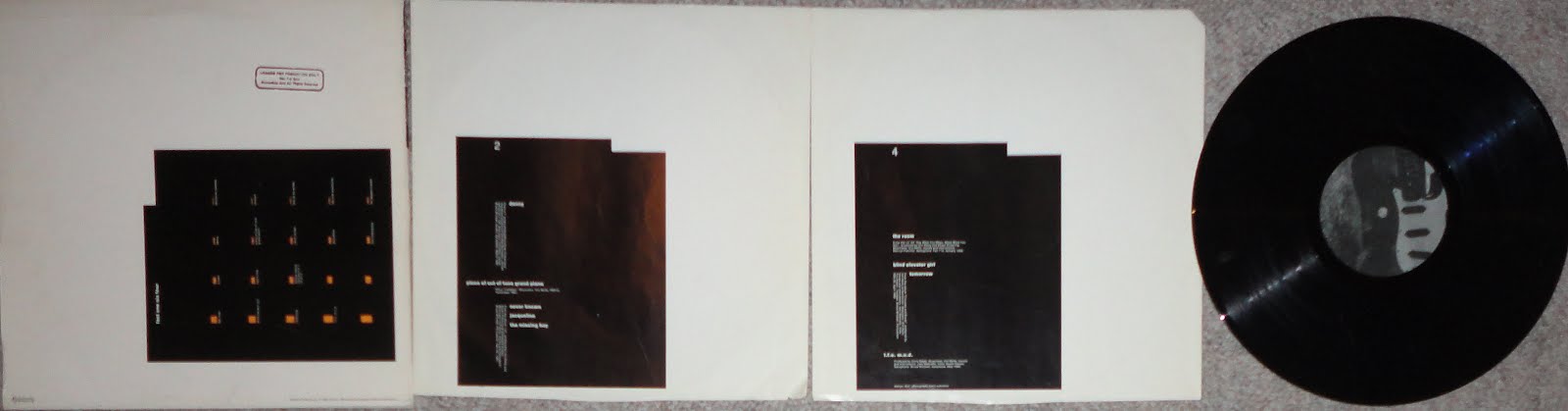
Valuable Passage - Cover, Sleeves, Record
Valuable Passage - Back, Sleeves, Record

Valuable Passage (1986)
11. Prayer 3:21
12. Spent Time 4:09
13. Without Mercy (4-7) 6:44
14. Without Mercy (10-12) 7:04/
15. The Room 5:58
16. Blind Elevator Girl 10:04
17. Tomorrow 4:02
18. LFO Mod 6:21

Album Rating (1-10): 4.5

Members & Other Bands:
Manunagh Fleming - Cor Anglais, Oboe
Chris Nagle - Producer
Vini Reilly - Bass, Piano, Drum Programming, Guitar, Vocals, Producer (Ed Banger & the Nosebleeds, Morrissey, Pauline Murray & the Invisible Girls)
Caroline Lavelle - Cello
Bruce Mitchell - Percussion, Congas, Xylophone, Drum Programming (Alberto Y Lost Trios Paranoias)
Anthony H Wilson - Producer
Michael Johnson - Producer
Mervyn Fletcher - Sax
Richard Henry - Trombone (London Scratch Orchestra, Stan Sulzmann Big Band)
Tim Kellett - Trumpet (Olive, Simply Red)
Blaine Reininger - Violin, Viola (Falling Infinities, Tuxedomoon)
John Metcalfe - Viola (Duke Quartet, Kreisler String Orchestra, London Scratch Orchestra, Millennia Ensemble)
Phil "Snake Davies" - Sax
8vo- Design
Peter Saville - Design
Kevin Cummins - Photographer
Stuart Pickering - Producer

Unknown-ness: I’ve never heard of this band. And let me start with saying that I bought this album with only record 2 inside. The sleeve for the first record is there, but the record was not. So I can only review the second half of this double album. The design looks cold, desolate and synthesized. It reminds me of OMD’s early design: square, black and white.

Album Review: “Prayer” is actually the start to side 3, not the album beginning, but seeing as this is a compilation; the album is not created for cohesive play. But this starts out solemn and dark, and it reminds me of “Warning Sign” by Hail Social. It is frosty, magical, and dreamy. It is slow and meandering, with no specific direction. It feels like it could have been useful in 80’s soap operas, in some sort of sad, reminiscing montage. It ends in an uplifting synth keyboard clarity, as if the dreamer was about to wake up
“Spent Time” has New Order-ish bass line, but the icy synth in the background really dates the production style. There are hushed, whispery monotone vocals barely sung and mixed in the background, a bit like Joy Division. The song is very repetitive, so it feels like a long song.
“Without Mercy (4-7)” begins with a repetitive, two liquidy, echoing guitar hooks overlapping and some strings in the background. It sounds like slowed down Mega Man level music. A trumpet is added later on, further accenting the trickling, liquid feeling the song creates: like ice melting and the water running below the still solid surface. It feels like it could go on forever, but it eventually just fades out.
“Without Mercy (10-12)” starts with a trumpet salute to royalty walking into a thrown room. This too is in somewhat slow motion, but it feels like, to me, that it is telling the story of two young royals courting and dancing together after an evenings’ feast.

“The Room” has electric beam effects echo across the soundscape. And what sounds like a Theremin is played in the background, quite repetitively. More quiet, reserved vocals are added sparingly to the background, creating a delicate and futuristic lullaby. I’m recalling imagery from the Ice Palace in The Never Ending Story.
“Blind Elevator Girl” is a long instrumental song, beginning with another welcoming royalty hook on repeat. It begins to sound like a real pop or prog composition with steady drums, and horns, but once the drums disappear, they take the rock song template with them, and the song reverts back to a meandering thought that could coalesce at any time. This song is actually a little jazz-funky with its combination of bass, guitar and horn.
“Tomorrow” feels like a Ween guitar ballad at the beginning. It is folky, and acoustic sounding, while still in the presence of echo. Unwavering vocals lightly sing over the guitar and plucked string accompaniment. The somber voice is comfortable with dying, by admitting “tomorrow never comes.” And once the horn is added, the music takes on a sad Belle & Sebastian quality.
“LFO Mod” is a little more organic in its piano and shuffling synth background. It changes synth settings about a minute and half in to be more bubbly and liquid, and is accompanied by an acoustic guitar crying out a fluttering Santana melody. Later, a stereotypic sexy sax is layered over the warbling, watery keyboard. It is as if the background template is set, and guest instruments take their turns jamming out overtop, creating a different vibe with each transition. And it ends in a fade out.

Stand Out Track: Tomorrow

Links:

Thursday, December 29, 2011

Lincoln - Mettle

Name: Lincoln
Album: Mettle
Year: 2002
Style: Quiet Folk, Country, Americana
Similar Bands: Bonnie Prince Billy, Neil Halstead, quiet Belle & Sebastian songs, Lewis & Clarke, later Gorky's Zygotic Mynci, Mazzy Star
"One-Word" Review: Hauntingly Minimal Winter Soundscapes
Based Out Of: London, England
Label: Narwhal Records, 3MV/Pinnacle, BMG
Mettle - Cover, Back, CD
Mettle - Liner Notes 1-2, CD Back
Mettle - Liner Notes 3-4, CD tray
Mettle - Liner Notes 5-6
Mettle - Liner Notes 7-8
Mettle - Liner Notes 9-10

Mettle (2002)
  1. My Reasons Are My Own 5:51
  2. Great Wall of China 5:11
  3. Interlude #3 0:56
  4. Crooked Smile 3:12
  5. Interlude #5 0:51
  6. Blood on the Streets 6:03
  7. Ghost Cat 4:41
  8. Interlude #8 0:45
  9. Mettle 5:47
  10. Interlude #10 1:35
  11. Never See London Again 5:57
  12. Common Ground 3:24
  13. How the Hell 4:33
  14. Interlude #14 1:40
Album Rating (1-10): 5.5

Members & Other bands:
Alex Gordon - Vocal, Guitar, Trumpet, Leys
Crum Hall - Drum, Percussion, Melodica, Violin, Vocal
David Hannam - Guitar, Clarinet, Harmonium, Banjo, Conductor (Culprit One)
Matt Dowse - Trombone, Fender Rhodes, Wine Glasses (Calexico, King Prawn)
Jum Freidlander - Bass, Trumpet, Wine Glasses, Art, Design, Photography
Tracy Van Daal - Vocal, Wine Glasses (Richard X)
Oliver Kraus - String Arrangement, Cello
Sophie Sirota - Viola
Howard Gott - Violin
Ali Friend - Upright Bass
Tom Hodges - Saw
Brian O'Shaughnessy - Overdub & Production
Sean Reed - Producer

Unknown-ness: I've never heard this Lincoln before. The problem is that I like the US band Lincoln, so I picked up this band with the same name, except they're from the UK. I remember listening to a little of it and putting it aside since it was not the band that I liked, but I cannot remember what this band sounded like. With all the instruments, and liner note of it being recorded in an open room, I'm guessing it is some kind of orchestral genre. Maybe I'll like this for different reasons? We shall see.

Album Review: “My Reasons Are My Own” begins with a sad, solemn piano. The vocals quietly start in, reminding me of Bonnie Prince Billy or Neil Halstead. They quiver and shake in their wispiness, and guide the slow melody, like snow falling outside a cabin window. A solidarity trumpet is added, and the song has moved to a quiet Belle & Sebastian song. The musical intermission brings a little peaceful country slide guitar to the front before returning for one last stanza. The song finishes out as quietly as it began, fading to the back.
“Great Wall of China” builds musically and orchestrally in the beginning, again like a frigid and frosty forest scene. The vocals are again, a faint whisper gently flowing with the melody. In the chorus, there is a female backing vocal, adding richness and emphasis to the lead. Musically, it reminds me of the quiet aspects from bands like Gorky’s Zygotic Mynci, Shout Out Louds, and Noah & The Whale.
“Interlude #3” is composed of a slowly building sunrise feeling.
“Crooked Smile” is more country than before, reminding me of later Gorky’s minus the accent. The vocals are shared guy/girl bringing that richness to the music. The horn section gives off a drunken lazy atmosphere. This song is sunnier and more down home, classic folk-country style. Perhaps Americana is the correct term.
“Interlude #5” starts with a sad bugle horn, and is added to with very minor supportive instrumentation for its short song
“Blood on the Streets” slowly sings along with female only vocals at first. The male accompaniment joins in and signals the song to start with another sunrise, awakening section. The song fakes moments where the pace might pick up, but it settles back into something consistent, and driving in its own swaying tempo. The songs feel longer than they are because they do drag, which is by design. The female vocals remind me a little of Neko Case.
“Ghost Cat” is an instrumental that continues the haunting, echoing, atmosphere, with only a trumpet to break through the sorrowful fog.

“Interlude #8” is a whirling echoing musical wind chime instrumental.“Mettle” slows down to a near halt with echoing slide guitar and piano chords played at a very methodically slow pace. This is very sparse and atmospheric. Near the end, the backing female vocals are added, sounding like it was sung in the round.
“Interlude #10” is another cold morning daybreak theme.
“Never See London Again” is a sad, minimal yet soulful female sung less-than-ballad. After about 2 minutes, more Mazzy Star elements are added, and the song becomes a slow country ballad.
“Common Ground” travels on the more folksy side of the genre map. It is still heavy on the slide guitar and there is a jangley guitar played sparingly in the background accompanied by some other string instruments, Cello I’d assume. The construction of these songs is not really structured with verse and chorus, they are much more free flowing.
“How the Hell” starts with sad horns and a melancholy forlorn feeling. There is a wind sound effect in the background, which is really a saw being played I believe. The female vocals, tinted with a sexy yearning, take over a little over halfway through, and the song really comes alive with a horn section, and an unprecedented strength in its composition.
“Interlude #14” ends the album with more singing saw and vocal syllables that start as nearly unintelligible, but grow in strength as the single musical idea, a reprise of How the Hell of sorts, is carried through.

Stand Out Track: My Reasons Are My Own

Links:

Friday, December 16, 2011

Badawi - The Heretic of Ether

Band: Badawi
Album: The Heretic of Ether
Year: 1999
Style: Ambient, Middle Eastern, Illbient
Similar Bands: John Zorn, Secret Cheifs 3
"One Word" Review: Environmental-Gypsy-Soundtrack
Based Out Of: Jerusalem / NYC
Label: Asphodel
The Heretic of Ether - Cover & Record
The Heretic of Ether - Back & Record

The Heretic of Ether (1999)
  1. Intro 1:17
  2. Tired Soldiers 5:44
  3. A Voice from Six Corners 2:49
  4. Santur 1:16
  5. Enter the Heretic 3:58
  6. Fatal Confrontation "The Death of Gashka Gavor" 1:29
  7. Enterance 3:23
  8. Arrival 5:57/
  9. Fatal Confrontation "Gashka Meets the Gate Keeper" 1:34
  10. Welcoming 5:23
  11. Falling 3:11
  12. Fatal Confrontation "Revisited" 2:10
  13. Return of the Heretic 6:11
  14. Awakening 4:45
Album Rating (1-10): 5.0

Members & Other Bands:
Erik Berglund - Composer
Hank Deckon - Composer
Ralph Farris - Violin (Ethel)
Raz Mesinai - Arranger, Keyboards, Percussion, Producer (Sub Dub)
Ashton Worthington - Design
Erich Schoen-Rene - Cello
Mixture 151 - Mastering

Unknown-ness: I’ve never heard of Badawi. From the name alone, I’m imagining that this is going to be some sort of Hardcore. And with the name like Heretic of Ether along with the scratch font and the b/w photography, I am further convinced that this will be hard core / metal.

Album Review: So I’ve researched and read upon this artist, and understand that this is nothing like Hard Core. It is instrumental Middle Eastern and Yiddish themed world music with a very ambient production, as it was recorded live in studio minus turntables or samples, according to Allmusic. Along with the artist’s background in dub step and reggae DJ, it should be an interesting listen. And since it is a themed concept album, I’m going to review it minus the tracks, pointing out highlights and notable sections.

Humming and what sound to be bagpipes start out the album. The composition is already a very atmospheric humming, like flying around clouds at a 15 frames per second scene. The repetition and grueling progress of the Middle Eastern instrumentation weaves an overworked web: “Tired Soldiers” works well as the title. The hum and intensity grow and show no end in sight. A deep cello finishes out to be followed by a buzzing bee sound. Beautiful and exotic Arabian picking echoing with a natural imperfect warbling follows, which is transplanted with calculated yet frantic piano playing on the next track. Rapid driving percussion begins and subsides leaving room for electronic, static bass and more Middle Eastern melodies, reminding me of something I could expect from Mike Patton (as I have a very small frame of potential comparison for this musical genre). Rapid and rolling tribal steel drum percussion makes up the next track. What feels like a reprise of the album’s buzzy beginning takes the record in a gyrating, and pressure building direction, like tension before an explosion. Sad violins take over, but the background hum/buzzing still remains. This has created the mental image of finding a rotting corpse of a loved one lying next to an open street gutter down a disused back alley in a foreign village.

Bongos of different percussive sounds rapidly beat to begin side two in a swirling rhythm that feels it may teeter over at any second. When it ends, deep warbling strings are played. There is a fine line here between Middle Eastern stand up bass and Mexican sixth string guitar play, and I can’t figure out which it sounds more like at various points, but either way it is a very percussive dance. I’ve never thought that Mexican and Arabic music could be similar or indistinguishable until now. Out of nowhere is a beautiful and magical tubular or xylophonic bell. This ends quickly, and is followed by a growing feedback of a violin string sound. In other words, more of the building buzzing sound. The final “Fatal Confrontation” succeeds, and as all the predecessors, it is all a rapid percussive dance. Following the dance is a gloomy castlevania-esq gothic string section, which, when added to with a steady, repetitive heavy bass beat and bongo percussion, takes a turn toward gypsy style. As this song nears the end, there is some sort of keyboard instrumentation that demands an anger and urgency, which stops abruptly and allows the record to finish in a sad story told by a violin.

"Stand-Out" Track: Enter the Heretic

Links:
Raz Mesinai

Monday, August 17, 2009

Joan of Arc - The Gap

Name: Joan of Arc
Album: The Gap
Year: 2000
Style: Electronic, Ambient, Folk
Similar Bands: Neil Halsted, Wilco
"One-Word" Review: Jarringly-mashed-up-folk-song-ideas
Based Out Of: Chicago, IL
Label: Jade Tree
The Gap - Cover and Insert Covers
The Gap - Back & Lyrics
The Gap - Record

The Gap (2000)
  1. (You)[I] Can Not See (You)[Me] As (I)[You]Can 3:19
  2. As Black Pants Make Cats Hair Appear 7:48
  3. Knife Fights Every Night 5:07
  4. John Cassavetes, Assata Shakur and Guy Debord Walk Into A Bar... 0:54
  5. Another Brick in the Gap, Pt. 2 2:57 /
  6. Zelda 1:56
  7. Pleasure Isn't Simple 3:18
  8. Me & America (or) United Colors of the Gap 5:18
  9. Your Impersonation This Morning of Me Last Night 9:11\
  10. Outside the Gap 2:45
Album Rating (1-10): 4.0
Members & Other Bands:
Tim Kinsella - (Cap'n Jazz, Owls, The Sky Corvair, Friend/Enemy, Everyoned, Make Believe)
Mike Kinsella - (Cap'n Jazz, Owls)
Todd Mattei - Photography (Friend/Enemy)
Jeremy Boyle - Keys (Cap'n Jazz)
Matt Clark
Elliot Dicks - Engineer
Alan Douches - Mastering
Rebecca Gates - Vocals (Spinanes)
Ryan Hembrey - Bass, Vox
Jeremy Lemos -Recording
Damon Locks - Vox
Casey Rice - Producer
Sheik LaBod - Additional Recording
Tania Bowers - Vox
Julie Pommeleau - Vox
Paul Koob - Art Direction & Design

Unknown-ness: I’ve never heard of these guys. Well, that’s not completely true. Since I began to research these guys, I came across a promo photo that I distinctly remembered and was interested in a few years back when I’d check out the local concert listings. So I have been familiar with them without really knowing who they were. This was a record that I got from a friend who moved to Chicago (ironically) and she gave this to me since she did not like it too much. I really do not know what to expect on this, except, from the minimal and busy artwork, perhaps some experimental and ambient noise mixed with standard indie fair.


Album Review: “You)[I] Can Not See (You)[Me] As (I)[You]Can” is a slow moving acoustic with echo lullaby. It reminds me of a Jeff Buckley sketch mixed with some James – Laid material. It has the liquid echo and light mid range vocals. But it is ultra simple. The vocals and music cut in and out at random points, and it is so random that I am not entirely sure that this is how the song sounds or if it is my recording of the record. The end increases in energy as a wall of sound builds until the song cuts out and makes way for the next track.
“As Black Pants Make Cats Hair Appear” is a tune up session of random little melodies played on the guitars and random drum fills. It feels like experimental Jazz with out any boundaries. The percussion includes a clanging of what sounds like glass bottles and metallic chains. Around 1:20 the music picks a melody and the drums support it and for another minute a tangible song evolves. But the percussion goes on its own for a few bars until it returns for the melodic chorus. It is repetitive but catchy. At different points a chorus of vocals or a wispy female voice overlaps the nasally lead vocals. There is a slow breakdown as the instruments, aside from the melody holding “dream guitar,” all decide to evolve in their own distinct directions. The instruments withdraw slowly, and a synthetic robotic chirp is added as the song repeats its chorus toward the sudden ending.
“Knife Fights Every Night” begins with a short section of melodic piano and strings, but if only this melody were maintained, I might be able to follow it much better. But the annoying tempo changes and instrument breaks make it hard to get a grasp on this song as anything more than an art form. A bass line echoes down the scale from high to low pitch until it distorts out of the song. Like a whale swimming by a submarine and or if a star’s Doppler shift would be audible. The vocals feel inconsequential, as just part of the music’s landscape, rather than being anything catchy to guide the song along.
“John Cassavetes, Assata Shakur and Guy Debord Walk Into A Bar...” is just a repetitive bass line with odd string picking sounds and slow rhythmic trash can percussion. Randomly picked guitars also become involves with the song, but they quickly end, leaving a repetitive siren like “spinning top” of a noise to finish out the track, which I think is actually “Another Brick in the Gap, Pt. 2” and I just cut it off before the entire track played out.

“Zelda” begins side 2 with what feels like a bunch of song ideas tied together with a lovely guitar. The drums are crashing and beating out of whack with the rest of the song, and it feels like two ideas were laid over to make one track, sometimes it matches nicely, sometimes one music pulls attention away from the rest of the song in a jarring way. The song transitions into “Pleasure Isn't Simple” and it feels like it is basically the same song.
“Me & America (or) United Colors of the Gap” starts off from the start sounding like a song, at least more so than the rest of the songs. The vocals are assured and have a distinct melody, and the music, drums included adapt the song pleasurably, rather than detracting. The bass line is a little off, but it plays out interestingly, and not detrimentally. The music cohesively takes over, and the string section flows in a fun fashion over the bass and depressed guitars. The drums are smooth and rhythmic in their play.
“Your Impersonation This Morning of Me Last Night” is again, a light acoustic guitar inspired song. As I feel I have to compare the music to being song-like or not, this is definitely more like the delicate intro to a moody, romantic folk ballad. The drums are mixed far down in the background and barely come out except the quick rat-a-tat fills and cymbals. About 2:30 in, the first vocals surface. Quiet, hushed monotone words pick up unusual melodies out of the backing music. The vocals begin to repeat, and sound like mentally ill ramblings, repeated over and over accompanied by a rocking motion for comfort. The vocals fade out in an echoy shuddering whirlpool of synth fuzz. The acoustic guitar continues to jangle out the rest of the song with the familiar melody it’s played for the entire 9 minute song.
“Outside the Gap” begins as soon as the guitar ends, with a phantom echoing bells and haunting, quiet buzzing and cymbals reverberating across the soundscape. There is no real melody here, just ambient ringing and a short set of vocals melodically talking over the end of the song, as if reading the album in epitaph.

Stand Out Track: Me & America (or) United Colors of the Gap

Links:
Allmusic
Wikipedia
website
Artist Direct
myspace
Tim Kinsella's Myspace?
Tim Kinsella Wiki
Last FM
The L Magazine

Thursday, March 12, 2009

Ghostwriters - Objects In Mirrors Are Closer Than They Appear

Name: Ghostwriters
Album: Objects In Mirrors Are Closer Than They Appear
Year: 1981
Style: Electronic, Ambient
Similar Bands: Residents, Mystic Knights of the Oingo Boingo, Kraftwerk
"One-Word" Review: minimal electro-ambien pop-sketches.
Based Out Of: Philadelphia, Pa
Label: Red Music
Objects In Mirrors Are Closer Than They Appear - Cover & Record
Objects In Mirrors Are Closer Than They Appear - Back & Record

Objects In Mirrors Are Closer Than They Appear (1981)
  1. Sleedermauseman/Reference to ROTA 6:30
  2. Emotional Momentum 3:31
  3. Swizzle 9:49 /
  4. Fix In The Mix 4:07
  5. Moon Chant 1:25
  6. Quark & Quarles 4:40
  7. On/Off 2:23
  8. Tarpit 6:52
Album Rating (1-10): 9.0

Members & Other Bands:
Gino Wong - Exec. Producer
Bill Mauchley - Mixer
Charles Cohen - Producer (Planet Y)
Jeff Cain - Producer

Unknown-ness: I’ve never heard of these guys. From the piano on its side and the duo’s clothing on the cover & back, they look like they are going to be some sort of Hall and Oates type act. I like the imagery on the cover, of only being able to see them in reverse through a mirror. The song titles are different from normal, standard radio pop titles, so perhaps they will stand apart from Hall & Oates.

Album Review: “Sleedermauseman/Reference to ROTA” is the first track from the album, and it is a watery, aquatic electro mix of deep, and resonating bell sounds, that reminds me of something between the Residents and Forbidden Zone. Perhaps with the repetitive, driving nature of Kraftwerk, added in too. It even harkens back to the devious spirit of the Spy Hunter theme. Around 3:45, the song changes, perhaps taking on the ROTA section of the song, and a piano element is introduced, putting a dead stop on the music’s momentum, and quieting the track down to single key strokes and a ominous hum. The tinkling becomes slightly more complicated, but it still creates an edge of your seat using minimal sound. The end of the track kills the momentum, or the song would be quite a stand out track. “Emotional Momentum” is next, with a tribal simple drum beat, (almost a heart beat), cricket noises and twittering of electronic effects. As if they are flying by your ears. The liquid bass effect is employed again, and the song slowly builds in complexity, but not in over use of any one effect. There are vocals added which are synthesized and turned around so much that the words are inaudible. “Swizzle” begins with an Atari “Break Out” sound effect repeating over and over while speeding up; which sounds fantastic. It is a little Close Encounters as well. A synthesized flute sound brings a mystical, ethereal feel to it too. After 2 minutes, it transfers into a delightful, pleasant call and response two melody synthesizer mix, while the break out bricks are still clanged with the ball in the background. This is a great mix of ambient sound and electronic toying. The dueling synthesizers are both tuned to have an Asian feel. “Swizzle” is quite an apt name for this track, as it fits perfectly in both the look and sound of the word. The background components of the song grow louder and slowly change and merge into one unified rhythmic beat. There is definitely some creative use of a theremin as well, adding to the catchiness and pop sense ability of the track. The song has each element detracted as the song completely slows down to a stop at the end.

“Fix In The Mix” features more of the darkness, Resident side of electro effects, rather than the happy “Swizzle.” It includes nervous vocals, part devo, all Residents-ish, which makes me question, could Cohen or Kain be one of the mysterious Residents? The industrial two beat electro bottom gives plenty of room for the odd sounds to play all over the place through out the song. These tracks are all really, really good, it is very hard to pick a favorite. And there are still four tracks left. So far, this is it, thanks to its length and consistency. “Moonchant” is a short minute and a half song that is very dark and quiet, and is basically a vocal enhanced chant, sounding a bit like Fad Gadget, with a barely present synth bass line. “Quark & Quarles” begins with a steady drum machine smack beat and some warbley liquid sounds. Now this is really my cup of tea as it is very evil carnivally in its Residents/Boingo presentation and noises that oscillate all over the sound spectrum. The noises get increasingly chaotic, but before it becomes annoying, they stop, and the song rebuilds itself through a slightly different beat. But the effects continue their watery, Star Wars robot language. Right as you think that the song is going to lose all musical consistency, they employ the carnival hook that the song begins with. “On/Off” is next, carrying on an echoey, distanced version of the last song, with a strong piano three note hook driving the song, as it goes down in octaves. It breaks down with a electro skat-like section, and regroups into the three-note section again. This is repeated, and the song finishes with a sped-up version of the three-note section, that goes a bit crazy, but stays in form. “Tarpit” ends this fantastic record, with minimal echoey effects, wind, and some sort of insect-like sounds. After a minute, “tarpit” bubbling sounds emerge, but not to any rhythm as of yet. They increase in numerousness and volume, while a clicking tempo is added. A synth keyboard effect is added, which mimics the careful stepping of someone who does not want to be found. The bubbling follows the stepping tempo and beat, and a reggae guitar melody is added. I really can’t believe that have actually created Ambient Reggae. They finally add what it sounds like prog to their mix, which I wouldn’t believe they;d been able to clock out of the record without bringing a bit of prog. The insect sound becomes louder in the end, and the song slinks out, as if it has passed you, not knowing you were there, and goes on with its own business around the corner. You are there left with the crickets.

Stand-Out Track: Quark & Quarles

Links:
Philly Punk